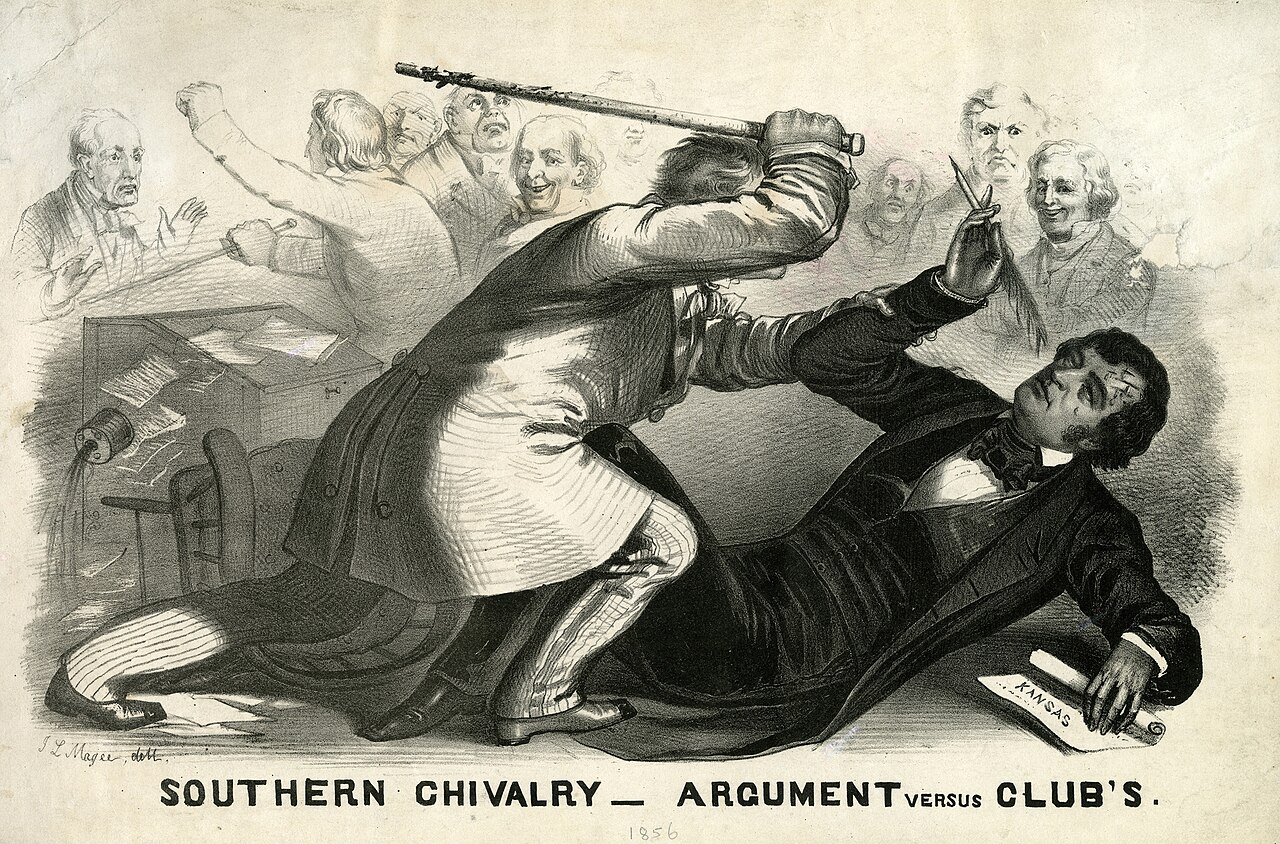
The "Crime Against Kansas": A Speech Ignites Senate Violence and National Division
The halls of the United States Senate have always been a stage for passionate debate, but few moments in American history rival the shocking violence that erupted on May 22, 1856. In an era already simmering with sectional tensions over slavery, an incident known as the
Caning Of Charles Sumner, or the Brooks–Sumner Affair, transcended mere political disagreement to become a brutal physical assault, signaling a dangerous breakdown of civil discourse. This event, born from fiery rhetoric and deep-seated ideological divides, left Senator Charles Sumner severely injured and further polarized a nation hurtling towards civil war.
At the heart of this dramatic confrontation was Sumner's two-day speech, delivered on May 19 and 20, 1856, titled "The Crime Against Kansas." This powerful, invective-laden address wasn't just a political argument; it was a moral condemnation of slavery and its proponents, delivered at a time when the "Bleeding Kansas" crisis had brought the issue of slavery's expansion to a violent head.
The Fiery Words: Sumner's "Crime Against Kansas" Speech
In 1854, the Kansas–Nebraska Act had repealed the Missouri Compromise, allowing settlers in new territories to decide for themselves whether to permit slavery through popular sovereignty. This immediately sparked fierce conflict in Kansas, as both pro-slavery and anti-slavery factions rushed to settle the territory, leading to widespread violence and fraud. It was against this backdrop of escalating bloodshed that Senator Charles Sumner, an ardent abolitionist Republican from Massachusetts, rose to speak.
Sumner's "Crime Against Kansas" speech was a scathing denunciation of the Act and, more broadly, of the "Slave Power"—the perceived political and economic influence of slave owners. He passionately argued for Kansas's immediate admission as a free state, painting a vivid and often gruesome picture of the moral depravity and political corruption he associated with slavery. He declared:
"Not in any common lust for power did this uncommon tragedy have its origin. It is the rape of a virgin Territory, compelling it to the hateful embrace of slavery; and it may be clearly traced to a depraved desire for a new Slave State, hideous offspring of such a crime, in the hope of adding to the power of slavery in the National Government."
His rhetoric was not merely abstract; it was intensely personal, targeting the architects and most vocal champions of the Kansas-Nebraska Act. Chief among these were Senator Stephen A. Douglas of Illinois and, more critically for the events that followed, Senator Andrew Butler of South Carolina. Sumner reserved some of his most vitriolic attacks for Butler, a pro-slavery Democrat and a respected elder statesman from the South.
Sumner, with deliberate and cutting sarcasm, described Butler as a "chivalrous knight" devoted to a "mistress," whom he identified as "the harlot, Slavery." He implied Butler's defense of slavery was an obsession with something inherently ugly and immoral, yet perceived as beautiful by its misguided defender. These were not simply political disagreements; they were direct challenges to Butler's character, integrity, and Southern honor—concepts held sacred in the antebellum South. The speech, particularly its personal attacks, was considered an unpardonable affront, one that demanded a response beyond mere words.
A Chivalrous "Retaliation": Preston Brooks's Assault
Among those who took Sumner's words as a profound insult was Representative Preston Brooks, a fellow Democrat from South Carolina and a distant relative of Senator Butler. Brooks, steeped in the Southern code of honor, felt that Sumner's disparagement of Butler, especially the implication of a "harlot mistress," had crossed an unforgivable line. For many Southerners, such a public verbal assault on a kinsman, particularly an elderly one, was a direct challenge to family honor that could not be left unanswered. A formal duel might have been an option for equals, but Brooks deemed Sumner's words so contemptible that a caning, a common punishment for those considered social inferiors, was the more appropriate response.
On May 22, 1856, two days after Sumner concluded his speech, Brooks entered the nearly empty Senate chamber. He found Sumner seated at his desk, working, seemingly unprepared for any confrontation. Approaching the unsuspecting senator, Brooks declared, "Mr. Sumner, I have read your speech twice over carefully. It is a libel on South Carolina, and Mr. Butler, who is a kinsman of mine." Before Sumner could react, Brooks began to repeatedly strike him over the head with a heavy gutta-percha cane.
The assault was brutal and swift. Pinned by his desk, Sumner struggled to rise and defend himself, but the blows rained down, shattering the cane over his head. The attack lasted roughly a minute, with around 30 strikes, before bystanders finally intervened. Sumner was left severely injured, unconscious, and bleeding profusely. He sustained grave head injuries, including damage to blood vessels and nerves, that would prevent his return to the Senate until December 1859—a recovery period of over three years. During his absence, the Massachusetts legislature famously refused to replace him, leaving his empty desk in the Senate as a stark and visible reminder of the shocking attack and a powerful symbol of Northern indignation. You can learn more about this pivotal moment in American history by reading
The Caning of Charles Sumner: A Pre-Civil War Catalyst.
Echoes of Violence: The Nation's Divided Response
The
Caning Of Charles Sumner sent shockwaves across the nation, but the reactions were starkly divided along sectional lines. In the North, Brooks was widely condemned as a savage barbarian, and the attack was seen as further proof of the inherent brutality of the slaveholding South. Sumner became a martyr for the abolitionist cause, his empty Senate seat a powerful symbol of the violence perpetrated against those who spoke out against slavery. Public indignation fueled anti-slavery sentiment and galvanized support for the nascent Republican Party.
Conversely, in the South, Brooks was hailed as a hero, a defender of Southern honor and chivalry. He received numerous canes, often inscribed with messages of support, to replace the one he broke over Sumner's head. Brooks's constituents overwhelmingly re-elected him after he resigned to face potential expulsion, underscoring the deep-seated belief among many Southerners that he had simply upheld a sacred duty. This polarized response highlighted the irreconcilable differences that had taken root between the North and South, showing how profoundly their moral frameworks had diverged.
Beyond the Cane: Lasting Impact and Lessons for Today
The Brooks–Sumner Affair was far more than a personal quarrel; it was a potent symbol of the "breakdown of reasoned discourse" that characterized the years leading up to the Civil War. It demonstrated a terrifying willingness to resort to physical violence when verbal arguments failed, or when perceived honor was challenged. This incident, alongside the ongoing bloodshed in "Bleeding Kansas," vividly illustrated that the national debate over slavery had devolved beyond political negotiation, entering a dangerous new phase where civility and legislative decorum were increasingly abandoned.
Historians often cite the
Caning Of Charles Sumner as a significant contributing factor to the country's accelerating polarization. It solidified perceptions on both sides: Northerners saw the South as barbaric and uncivilized, while Southerners viewed the North as fanatical and disrespectful. This mutual animosity eroded any remaining bridges of compromise and strengthened the resolve of radicals on both sides. The event underscored the fragility of democratic institutions when fundamental disagreements are allowed to escalate into personal attacks and physical violence. To delve deeper into the broader implications, consider reading
Senate Attack: Brooks–Sumner Affair and US Polarization.
Lessons from History:
- The Peril of Dehumanization: Sumner's speech, while powerful, dehumanized his opponents, particularly Butler. Brooks's actions, in turn, dehumanized Sumner. Such rhetoric can quickly escalate to violence when one party is seen as less than human or beyond reasonable debate.
- The Importance of Civil Discourse: Even in moments of profound disagreement, maintaining respect for opposing viewpoints and adhering to parliamentary procedure is crucial for a functioning democracy. The caning tragically showcased what happens when those boundaries are breached.
- The Ripple Effect of Political Violence: Individual acts of violence in a political context can have immense, far-reaching consequences, contributing to a climate of fear and further division.
In retrospect, the caning of Charles Sumner stands as a stark reminder of a nation on the brink. It revealed how deeply entrenched the issue of slavery had become, capable of provoking extreme reactions even within the hallowed halls of Congress. The blows of Preston Brooks's cane on Charles Sumner's head were not just an attack on an individual; they were a strike against the very ideals of legislative debate and compromise, foreshadowing the much larger, more devastating conflict that would soon engulf the United States.
Conclusion
The
Caning Of Charles Sumner remains one of the most shocking episodes in American political history. It was a visceral manifestation of the deep-seated divisions plaguing the nation in the mid-19th century, directly stemming from the inflammatory "Crime Against Kansas" speech. Far from being an isolated incident, this brutal assault in the Senate chamber perfectly encapsulated the increasing inability of the North and South to resolve their differences through peaceful means. As the memory of Sumner's empty desk and Brooks's shattered cane lingered, the event solidified existing animosities and played a crucial role in accelerating the country's trajectory toward the American Civil War, serving as a powerful, albeit tragic, symbol of a democracy pushed to its breaking point.