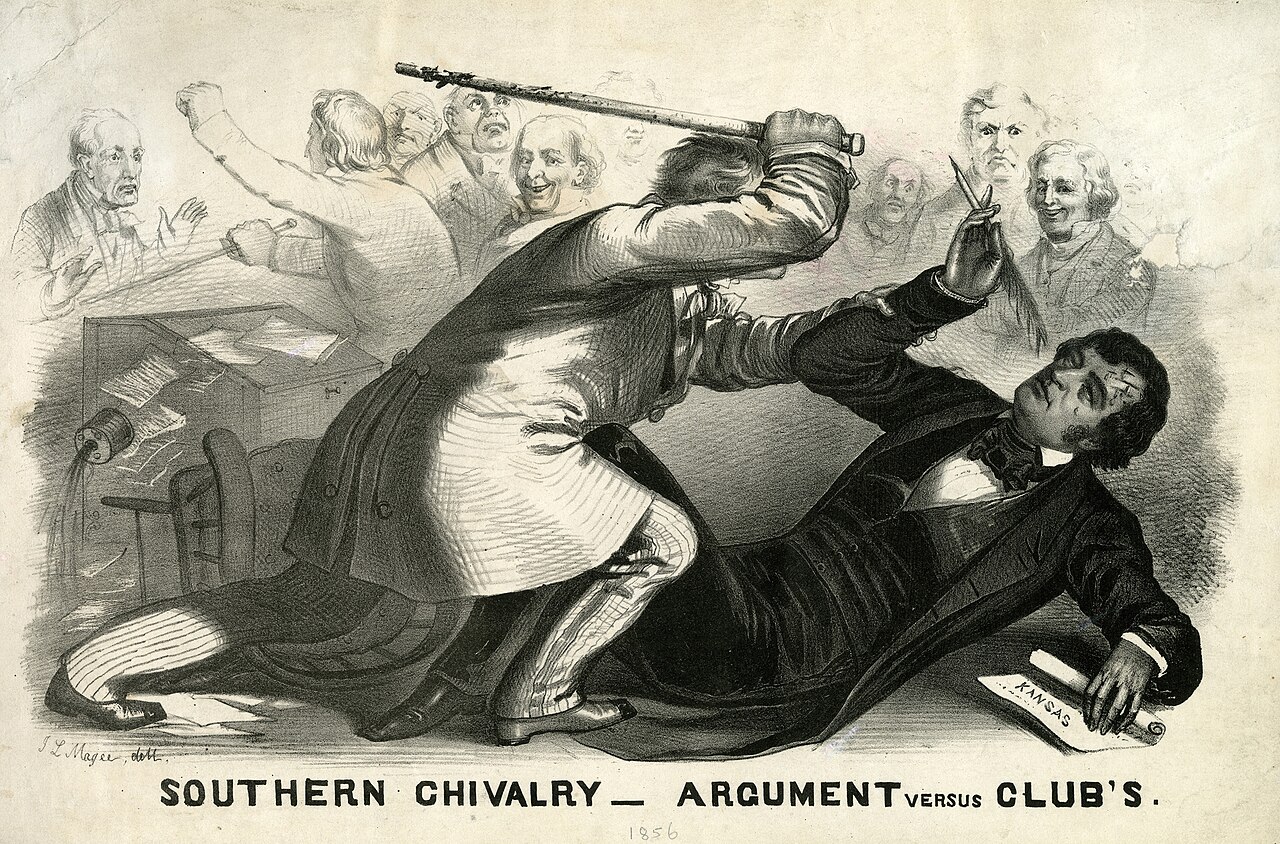
The Caning of Charles Sumner: A Pre-Civil War Catalyst
May 22, 1856, marked a moment that would forever stain the halls of the U.S. Senate and stand as a chilling precursor to the American Civil War. The brutal Caning of Charles Sumner by Representative Preston Brooks was not merely a physical assault; it was a visceral manifestation of the deep-seated divisions tearing the nation apart over the issue of slavery. This shocking incident, often referred to as the Brooks-Sumner Affair, served as a stark symbol of the breakdown of reasoned discourse and the escalating willingness to resort to violence that ultimately plunged the United States into its bloodiest conflict.
The Seeds of Conflict: "Bleeding Kansas" and Sumner's Fiery Speech
To truly understand the visceral nature of the Caning of Charles Sumner, one must look to the tumultuous political landscape of the mid-1850s. The Kansas-Nebraska Act of 1854, championed by Senator Stephen A. Douglas, effectively repealed the Missouri Compromise and introduced the concept of "popular sovereignty," allowing residents of new territories to decide for themselves whether to permit slavery. This decision ignited a firestorm of controversy, particularly in the Kansas Territory, where pro-slavery and anti-slavery factions clashed violently in what became known as "Bleeding Kansas." The territory was a microcosm of the national struggle, with fraudulent elections, raids, and bloodshed becoming commonplace.
It was against this volatile backdrop that Senator Charles Sumner, an ardent abolitionist Republican from Massachusetts, rose in the Senate chamber on May 19 and 20, 1856, to deliver his blistering address, "The Crime Against Kansas." Over two days, Sumner launched an invective-laden tirade, meticulously denouncing the Kansas-Nebraska Act and what he termed the "Slave Power"—the perceived conspiracy of slaveholders and their political allies to expand slavery. His speech argued passionately for Kansas's immediate admission as a free state, painting a vivid picture of the territory being subjected to "the rape of a virgin Territory, compelling it to the hateful embrace of slavery."
Sumner’s rhetoric spared no one, but he reserved particular venom for Senator Andrew Butler of South Carolina, a distant relative of Brooks and a staunch defender of slavery. Sumner cruelly mocked Butler’s "chivalrous" sentiments, suggesting he had chosen "a mistress to whom he has made his vows, and who, though ugly to others, is always lovely to him; though polluted in the sight of the world, is chaste in his sight—I mean the harlot, Slavery." These deeply personal and demeaning insults were a deliberate provocation, aimed at striking at the very core of Southern honor and the perceived moral depravity of slavery itself. For an in-depth look at this pivotal address, explore "Crime Against Kansas": How Sumner's Speech Led to Senate Violence.
The Brutal Assault: A Breakdown of Decorum
The raw aggression of Sumner's speech was too much for many Southerners to bear, but none more so than Representative Preston Brooks. Viewing Sumner's remarks as an unforgivable affront to his elderly relative, Senator Butler, and by extension, the entire state of South Carolina and Southern honor, Brooks felt compelled to act. The unwritten code of Southern chivalry dictated a duel for such a grievous insult between equals. However, Brooks deemed Sumner a social inferior due to his perceived vulgarity, thus precluding a formal challenge. Instead, he chose a public, physical chastisement.
On May 22, 1856, two days after Sumner concluded his speech, Brooks entered the nearly empty Senate chamber. He found Sumner seated at his desk, engrossed in writing. Approaching the unsuspecting senator, Brooks declared, "Mr. Sumner, I have read your speech twice over carefully. It is a libel on South Carolina, and Mr. Butler, who is a kinsman of mine." Before Sumner could react, Brooks began to beat him repeatedly over the head with a heavy gutta-percha cane. Pinned by his desk, Sumner was unable to defend himself or rise. Brooks struck him with approximately 30 blows until the cane shattered, leaving Sumner severely injured, bleeding profusely, and unconscious. Bystanders eventually intervened, pulling Brooks away from the prone senator.
The attack, lasting roughly one minute, left Sumner with grave head injuries, including damage to blood vessels and nerves. This wasn't just an assault; it was a symbolic violation of the legislative sanctity, a moment where the promise of reasoned debate gave way to primitive violence, perfectly encapsulating the growing national crisis. It highlighted how deeply personal and irreconcilable the issue of slavery had become, signaling a dangerous shift from political argument to physical confrontation.
Immediate Aftermath and Enduring Symbolism
The immediate fallout from the Caning of Charles Sumner was a stark testament to the nation's deepening polarization. In the North, the incident was met with widespread outrage and condemnation. Sumner became a martyr for the abolitionist cause, a symbol of Southern barbarity and the "Slave Power's" willingness to suppress dissent through violence. The Massachusetts legislature, in a powerful act of defiance, refused to replace Sumner, leaving his empty Senate desk as a constant, public reminder of the attack and a silent protest against slavery and Southern aggression. Sumner would endure years of painful recovery, unable to return to the Senate until December 1859, his health permanently compromised.
In the South, however, Preston Brooks was hailed as a hero. He received an outpouring of support, including gifts of new canes engraved with messages like "Hit him again." Though censured by the House of Representatives and fined by a court, Brooks resigned his seat only to be overwhelmingly re-elected by his constituents. This stark divergence in reactions—Brooks lauded as a defender of Southern honor in one region, condemned as a savage assailant in another—underscored the irreconcilable moral and cultural chasm that now separated North and South. The broken cane became an iconic image, a physical embodiment of the shattered unity of the nation.
A Precursor to War: The Caning's Legacy
The Caning of Charles Sumner transcended a mere incident of congressional violence; it became a powerful catalyst on the road to the Civil War. It vividly demonstrated that the crisis over slavery had escalated beyond political maneuvering and compromise, entering a dangerous realm where physical violence and emotional outrage dictated actions. The event amplified fears in the North of an aggressive "Slave Power" that would stop at nothing to expand and protect its interests, even resorting to assaults within the very chambers of government.
For many, the caning proved that reasoned discourse and democratic processes were no longer sufficient to bridge the chasm between the sections. It further radicalized both sides: abolitionists saw the act as confirmation of the inherent brutality of slavery and its proponents, while Southerners felt increasingly persecuted and misunderstood, driven to defend their way of life and honor by any means necessary. The incident solidified the perception that the nation was indeed two distinct and warring entities, sharing a government but little else.
In retrospect, the Brooks–Sumner Affair stands as a profound historical lesson. It illustrates the profound dangers of dehumanizing political opponents and allowing rhetoric to spiral into personal attacks. It underscores how the erosion of civility and the willingness to abandon democratic norms can swiftly lead a society down a path of escalating conflict. The Caning of Charles Sumner, therefore, remains a potent symbol of a nation's fragility when its core values are in such fundamental disagreement that violence becomes an acceptable form of political expression.
The Caning of Charles Sumner was more than just a shocking act of violence; it was a political earthquake that reverberated across the nation. It illuminated the depth of the animosity between North and South, solidified partisan lines, and demonstrated that the issue of slavery had pushed the United States to the brink. This brutal assault in the very heart of American democracy served as an indelible omen, signaling that the era of compromise was ending and that a more terrible conflict was fast approaching.