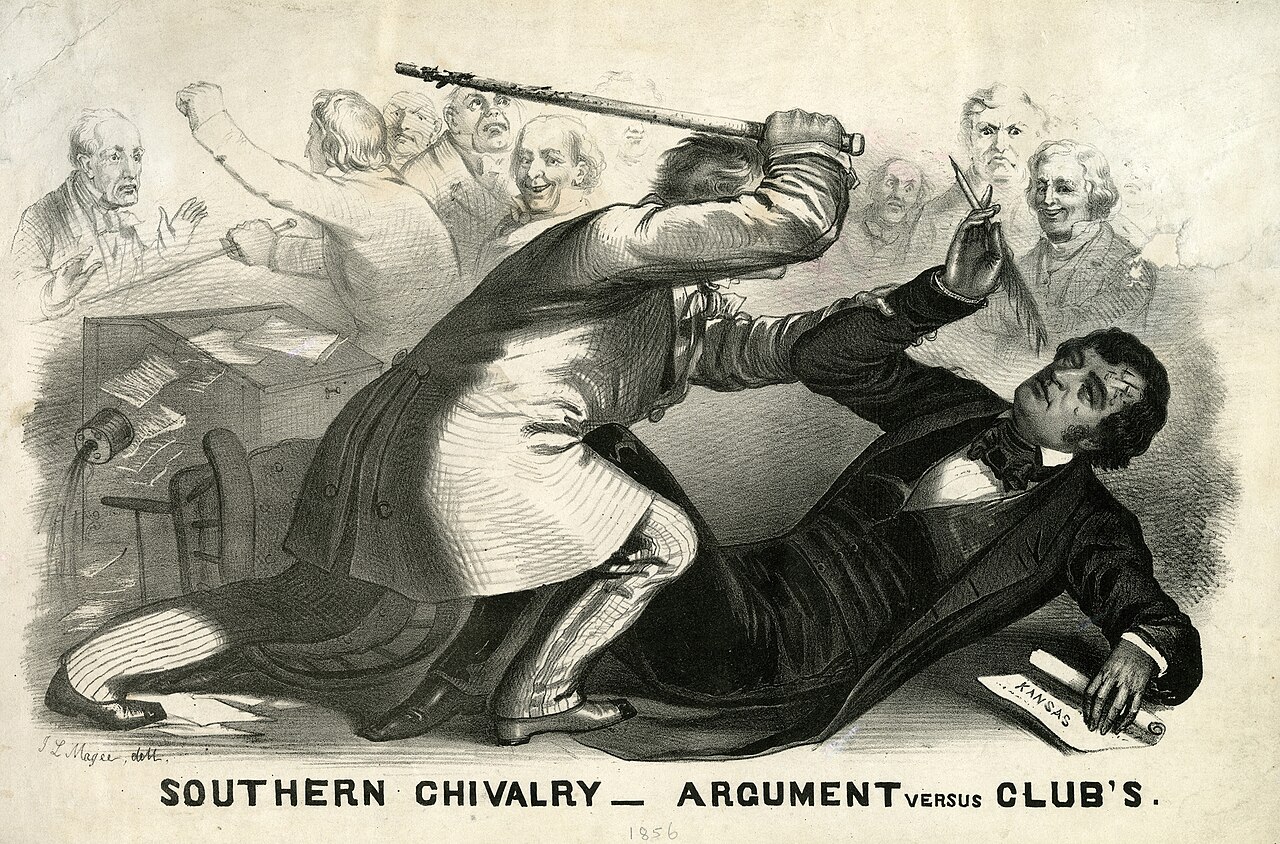
In the annals of American political history, few events are as starkly illustrative of deep-seated divisions and the tragic breakdown of discourse as the Caning of Charles Sumner. On May 22, 1856, the United States Senate chamber, usually a bastion of deliberative debate, became the scene of a brutal physical assault. Representative Preston Brooks, a pro-slavery Democrat from South Carolina, savagely beat Senator Charles Sumner, an ardent abolitionist Republican from Massachusetts, with a walking cane. This act, often referred to as the Brooks–Sumner Affair, was more than just an altercation; it was a visceral manifestation of the escalating tensions that would plunge the nation into civil war just a few years later, symbolizing a profound rupture in reasoned political engagement and a willingness to resort to violence.
The Unthinkable Attack: A Day of Infamy in the Senate
The roots of the Caning of Charles Sumner lay in the heated congressional debates surrounding the Kansas–Nebraska Act of 1854. This legislation ignited the "Bleeding Kansas" crisis, as it allowed residents of new territories to decide for themselves whether to permit slavery, effectively nullifying the Missouri Compromise. The resulting violence in Kansas, where pro-slavery and anti-slavery settlers clashed, mirrored the deepening national divide.
It was against this volatile backdrop that Senator Charles Sumner delivered his now-infamous "Crime Against Kansas" speech on May 19 and 20, 1856. A passionate and uncompromising abolitionist, Sumner used his platform to vehemently denounce the Kansas–Nebraska Act and the political force he dubbed the "Slave Power." His rhetoric was unsparing, particularly in its personal attacks. He targeted the Act's authors, among them Senator Stephen A. Douglas of Illinois and, most critically, Senator Andrew Butler of South Carolina. Butler, an elderly and well-respected figure in the South, was not only criticized for his pro-slavery stance but was subjected to highly personal and demeaning insults.
Sumner famously likened Butler's devotion to slavery to a chivalric knight's obsession with a "mistress" he called "the harlot, Slavery." He accused Butler of having "chosen a mistress to whom he has made his vows, and who, though ugly to others, is always lovely to him; though polluted in the sight of the world, is chaste in his sight." Such language, loaded with sexual innuendo and personal affront, was designed to wound deeply, particularly within the context of Southern honor culture. For a deeper dive into this pivotal speech, explore "Crime Against Kansas": How Sumner's Speech Led to Senate Violence.
Preston Brooks, a Representative from South Carolina and a distant cousin of Andrew Butler, perceived Sumner's speech as an unforgivable insult to his family, his state, and the entire Southern way of life. Adhering to the Southern code of honor, which often demanded a physical response to verbal affronts deemed beyond the pale, Brooks felt compelled to retaliate. A formal duel was considered but dismissed; Brooks believed Sumner was not a social equal and thus unworthy of such a gentlemanly challenge. Instead, he chose a public chastisement.
Two days after Sumner’s speech, on May 22, Brooks entered the nearly empty Senate chamber. He found Sumner seated at his desk, engrossed in writing, and thus unable to properly defend himself. Brooks confronted Sumner, declared his intent to avenge the insults against South Carolina and Butler, and then commenced a brutal assault with a gutta-percha cane. Brooks struck Sumner repeatedly and ferociously, shattering the cane over his head. Sumner, pinned by his desk, struggled to escape but was severely injured and rendered unconscious. The attack, lasting roughly one minute, left Sumner bleeding profusely on the Senate floor until bystanders finally intervened.
The Aftermath: A Nation Divided and a Symbol of Disunion
The immediate consequences of the Caning of Charles Sumner were profound and far-reaching. Sumner sustained grave head injuries, including damage to blood vessels and nerves, which rendered him unable to return to the Senate for over three years. During his prolonged absence, the Massachusetts legislature, in a powerful act of defiance and protest, refused to replace him. Sumner's empty desk in the Senate chamber stood as a stark and constant physical reminder of the attack, a silent testament to the violence that had marred the nation's legislative body and symbolized the fractured state of American politics.
The nation's reaction to the Brooks–Sumner Affair perfectly mirrored its deep sectional divisions. In the North, Sumner was hailed as a martyr for the anti-slavery cause. His injuries galvanized abolitionist sentiment, further convincing many that the South was barbaric and inherently violent, unwilling to tolerate even verbal opposition. Fundraising efforts for Sumner were widespread, and his story became a rallying cry for the Republican Party, which capitalized on the outrage to bolster its anti-slavery platform.
Conversely, in the South, Preston Brooks was lauded as a hero who had valiantly defended Southern honor. He received numerous canes, gifts, and accolades from constituents and admirers who saw his actions as a necessary response to an intolerable provocation. Though he resigned his seat in the House, he was overwhelmingly re-elected by the people of South Carolina, a clear sign of widespread Southern approval for his actions. The House of Representatives itself moved to censure Brooks, but efforts to expel him failed to reach the necessary two-thirds majority. While Brooks paid a nominal fine in criminal court, he faced no significant legal or political repercussions from his constituents.
The Brooks–Sumner Affair did more than simply highlight existing divisions; it actively deepened them. It stripped away any lingering illusions of civility in political discourse, demonstrating a dangerous willingness to resort to physical violence when ideological differences became irreconcilable. This event, alongside "Bleeding Kansas," became a potent symbol of the "breakdown of reasoned discourse" and an ominous precursor to the full-scale conflict of the American Civil War.
Echoes of the Past: Connecting 19th-Century Polarization to Modern Discourse
The Caning of Charles Sumner remains a chilling historical marker, a potent reminder that political polarization can, under extreme circumstances, devolve into physical confrontation. While modern political debates rarely descend into cane-wielding assaults, the underlying dynamics that fueled the Brooks–Sumner Affair bear uncomfortable resemblances to contemporary challenges in political discourse. The affair vividly illustrates several pitfalls that can undermine democratic processes:
- Dehumanizing Rhetoric: Sumner's speech, while advocating for a just cause, resorted to deeply personal and dehumanizing attacks on Senator Butler. Such rhetoric, whether through direct insults, character assassination, or the systematic demonization of political opponents, erodes mutual respect and makes reasoned debate incredibly difficult. When opponents are no longer seen as fellow citizens with differing views but as inherently evil or immoral, the path to compromise becomes almost impossible.
- The Erosion of Civility: The concept of "Southern honor" that motivated Brooks, while culturally specific, represents a broader failure of civility. When personal feelings of outrage supersede parliamentary rules and the expectation of decorum, the foundations of democratic institutions are threatened. In today's highly charged political environment, the constant erosion of civility in public discourse, whether online or in person, contributes to an atmosphere where extreme reactions can fester.
- Cultural and Ideological Divides: The 19th-century debate over slavery was an existential conflict that cut across economic, moral, and social lines, creating two irreconcilable visions for the nation. Today, while the specific issues differ, profound cultural and ideological divides on topics ranging from social justice to economic policy create similar pressures. When these divides become absolute, framing issues as battles between "good" and "evil," the potential for gridlock and radicalization increases.
- The Role of Media and Public Opinion: Just as newspapers of the era magnified sectional outrage, modern media, particularly social media, can amplify partisan narratives and emotional responses, making it harder for moderate voices to be heard. The immediate and widespread reaction to the caning, both North and South, demonstrates how public opinion, shaped by partisan lenses, can either condemn or condone violence based on pre-existing loyalties.
Understanding these parallels isn't about predicting another caning, but about recognizing the warning signs when political disagreements begin to transcend policy and attack the very humanity of opponents. The affair serves as a crucial historical lesson in the fragility of democratic norms when ideological battles become intensely personal.
Lessons from the Brooks–Sumner Affair: Safeguarding Democratic Discourse
The tragedy of the Brooks–Sumner Affair offers enduring lessons for preserving the integrity of political discourse and preventing the escalation of conflict in divided societies. While we live in a different era, the principles remain timeless:
- Prioritize Respect, Even in Disagreement: While passionate debate is essential for democracy, it must be tempered with respect for the individual. Focus criticism on ideas, policies, and actions, rather than resorting to personal insults or character attacks. "Strong opinions, loosely held" is a useful mantra, allowing for robust argument without demonizing the other side.
- Uphold Institutional Norms: The Senate chamber was a place for debate, not violence. Maintaining the integrity and decorum of legislative bodies and public forums is crucial. When norms are disregarded, the space for reasoned deliberation shrinks, inviting chaos.
- Cultivate Empathy and Understanding: Even when opposing views seem incomprehensible, making an effort to understand the underlying values, fears, and experiences of those who hold them can prevent the dehumanization that fuels conflict. This doesn't mean condoning harmful ideologies, but rather approaching dialogue with a more nuanced perspective.
- Beware of Echo Chambers: Both Brooks and Sumner were supported by their respective "camps," which reinforced their convictions and justified their extreme actions/rhetoric. Actively seeking out diverse perspectives and challenging one's own assumptions can mitigate the polarizing effects of ideological echo chambers.
- Recognize the Slippery Slope: The Caning of Charles Sumner didn't happen in a vacuum; it was the culmination of years of escalating rhetoric and unresolved conflict. Leaders and citizens alike must be vigilant for early signs of deteriorating discourse and be proactive in de-escalating tensions before they reach a breaking point.
- Champion Free Speech, But Condemn Incitement: Sumner had a right to express his views, however inflammatory. However, there's a critical line between free expression and speech that directly incites violence. Democracies must grapple with how to protect robust debate while preventing rhetoric that actively endangers individuals or institutions.
These practical insights, drawn from a dark moment in American history, emphasize that safeguarding democratic discourse requires constant vigilance, a commitment to civility, and a firm rejection of violence as a political tool.
The Caning of Charles Sumner stands as a stark and enduring symbol of how deeply held convictions, when coupled with unbridled personal attacks and a breakdown of civility, can lead to violence and tear a nation apart. This infamous Senate attack was not merely an isolated incident but a pivotal moment that accelerated the United States' march towards the Civil War, exposing the raw nerves of a polarized society. Its legacy continues to serve as a potent historical lesson, urging us to reflect on the nature of our political discourse, the importance of mutual respect, and the fragility of democratic institutions when ideological differences are allowed to override shared humanity. By understanding the gravity of this past event, we are better equipped to navigate the challenges of polarization in our own time and strive for a more constructive and respectful political environment.